
What Timothée Chalamet’s town hall disaster teaches every business leader — including the ones who think they don’t care about any of this.
There is a particular kind of reputation damage that does not arrive with warning. It does not come from a scandal, a lawsuit, or a product failure. It arrives in a single unguarded sentence — delivered casually, in a format that felt safe, to an audience that was paying far more attention than you thought.
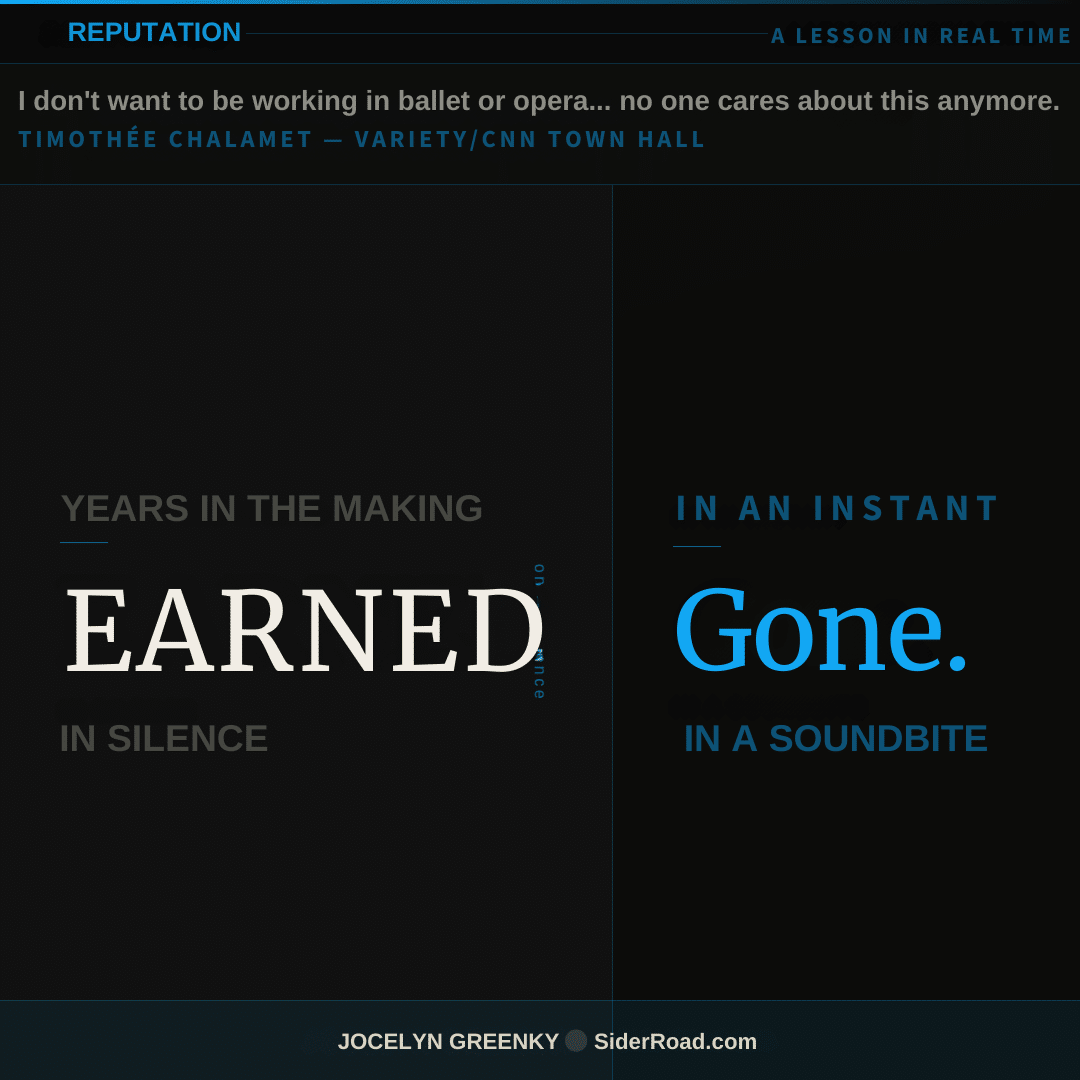
Timothée Chalamet recently discovered this. At a public town hall alongside Matthew McConaughey, he remarked that he had no interest in working in ballet or opera — describing them as things where it’s like, “no one cares about this anymore.”
What followed was swift, merciless, and deeply entertaining — if you weren’t him.
Every arts institution, every ballerina with a social media account, every opera donor who has ever sat through four hours of Wagner felt personally addressed. The clip went everywhere. The takes multiplied. A man who had spent years positioning himself as a serious, thoughtful artist suddenly had a very different headline to manage.
He is a film actor. But the lesson is identical for anyone who leads, owns, or represents a business.
If anything, the stakes in the boardroom are higher — because in business, the audience includes your clients, your competitors, your investors, and the media. Simultaneously. Always.
The myth of the “off moment”
Most leaders believe their reputation lives in their prepared remarks.
The keynote.
The investor letter.
The press statement crafted with three lawyers and a PR firm in the room.
Those, they treat carefully.
What they chronically underestimate is everything else.
The podcast that feels like a conversation.
The industry panel where the moderator is charming and you’ve had a drink.
The town hall framed as “just a chat.”
These are not reputation-free zones.
They are reputation accelerators — because audiences trust what feels unscripted, and they share it accordingly.
Authenticity is not the same as unguardedness.
You can be genuine and still be intentional. You can be candid and still be considered.
The moment leaders conflate being relaxed with being off duty from their own values — that is precisely when the soundbite is born.
But what if you want the loud reputation?
Here is where I want to speak directly to a certain kind of leader — the ones reading this with a slight smirk, thinking:
I don’t want a polished reputation. I want the real one. The unfiltered one. The one that says exactly what I think and lets people take it or leave it.
Fine.
That can work.
Some of the most commercially successful people in business have built their brand on being outrageous, contrarian, or gloriously unbothered by what anyone thinks.
It is a legitimate strategy. The world has room for a few of them.
But here is the non negotiable:
Even that has to be a choice.
A deliberate, eyes open, this is my brand choice — not an accident that happened because you were tired, relaxed, or underestimated the room.
The difference between a brilliantly calculated provocateur and someone who just said the wrong thing at the wrong time?
The provocateur knew exactly what they were doing.
They chose the moment, the words, and the audience. They were ready for the reaction — and had already decided it was worth it.
Chalamet was not doing that.
He was just talking.
And that is the distinction that costs people everything.
Loose lips can be a brand.
They cannot be an accident.
The market does not distinguish between boldly intentional and simply not thinking.
But your clients, your competitors, and your community absolutely will — eventually, and at the worst possible moment.
What actually builds a durable reputation?
Reputation is not managed in moments of crisis.
It is built — or quietly dismantled — in the hundreds of small, ambient interactions that precede them.
Every public word is a signal.
Every casual remark in a semi public setting is a data point.
And your audience is always constructing a picture from those signals, whether you are paying attention or not.
The leaders who build reputations that last are not those who say the most, or the least.
They are those who know precisely what they stand for before they open their mouths — in the prepared address and in the off the cuff remark alike.
They have made a decision about their own story, and they tell it consistently, even when they think no one important is in the room.
One careless sentence does not define you.
But it does reveal you.
And in an era when everything is recorded, clipped, captioned, and shared within minutes — the market, the media, and your community are always, unfailingly, listening.
Choose your reputation deliberately.
Even if the reputation you choose is the one that doesn’t care what anyone thinks — that choice still has to be made on purpose.
These questions — and the frameworks for building, protecting, and yes, strategically disrupting your reputation — are at the heart of my next book, coming soon.
If this resonates with where you are right now, I’d love to hear from you.