
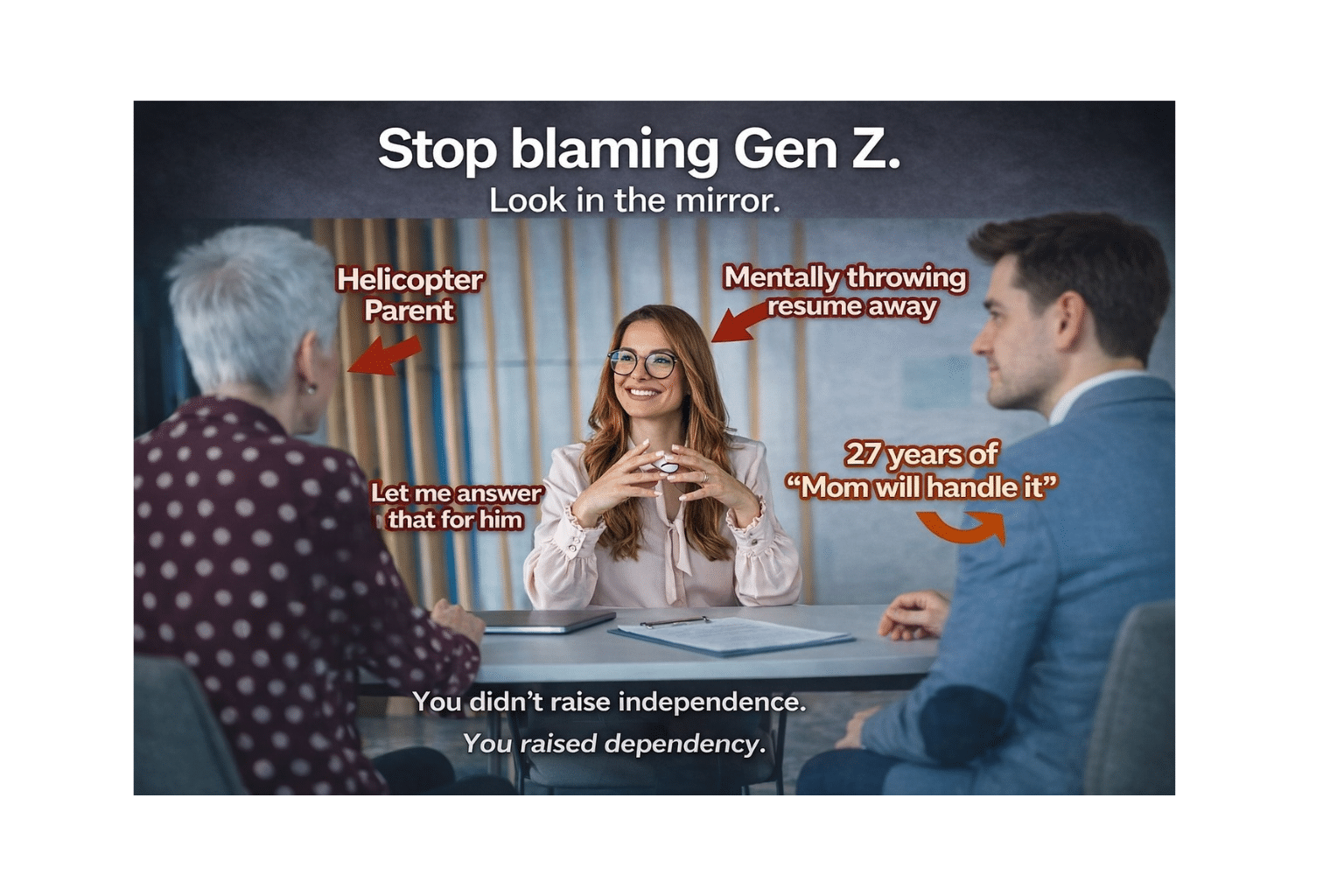
Stop Blaming Gen Z. Look In the Mirror.
Are these kids showing up to job interviews high? Genuinely asking — because I personally know CHROs who get calls from parents when their adult child gets feedback at work. As in, a grown person received constructive criticism from their employer and their mom picked up the phone.
What would the upside even be? “Hi, yes, I’d like to dispute the performance review of my 27-year-old?”
But here we are.
One in five Gen Z job seekers are bringing a parent to their job interview. Some are letting mom or dad negotiate their salary. A third say their parents have more influence over their career choices than anyone else.
And everyone is losing their mind about Gen Z.
Kevin O’Leary went on Fox Business and announced that any candidate who brings a parent to an interview gets their résumé thrown “right into the garbage.” Hard agree. I’ve hired well over a thousand people across a 40-year career, and if someone even hinted that a parent was in the picture, sayonara.
LinkedIn lit up calling this generation coddled, unprepared, and soft.
Here’s the thing nobody wants to say at their own dinner table.
We did this.
Not Gen Z. Us. The people currently forwarding these articles to their HR directors while simultaneously texting their 25-year-old to follow up on that application.
Let me be direct.
I work with family business owners for a living. Founders, patriarchs, matriarchs, second-generation operators, people trying to build something that outlasts them. And when I saw this story, I didn’t see a Gen Z problem.
I saw a mirror.
An uncomfortable, high-definition, absolutely-no-filter mirror.
The parent who calls a hiring manager to put in a good word for their 24-year-old? That’s the same parent who called the teacher when their kid got a C. Who escalated to the principal when there was a conflict with a coach. Who smoothed every rough edge, fought every battle, and resolved every problem before their child had a chance to fail through it themselves.
We didn’t accidentally raise a generation of adults who don’t know how to sit alone in a waiting room.
We engineered it.
One helicopter moment at a time. With love and the best of intentions and an absolutely catastrophic outcome.
And now we’re clutching our pearls that they brought backup.
Here’s where it gets really fun for anyone who owns or runs a family business. Because there’s a very good chance you’re doing both of these things simultaneously, possibly from the same desk chair.
You’re frustrated by young employees who can’t handle feedback, lack initiative, and need their hand held through every decision. You’re nodding along to the Kevin O’Leary clip. Maybe you even forwarded it.
And tonight, you’re going home and editing your kid’s résumé, texting them to follow up on an application, and — be honest — maybe making a call or two on their behalf.
That’s not irony.
That’s a pattern.
And it runs straight through the heart of how family businesses collapse.
The families I work with who struggle most with succession aren’t the ones with the wrong next-generation candidate. They’re the ones where the founder never actually let go. Never handed the next generation a real problem and walked away. Never let them fail, struggle, course-correct, and build the only thing you can’t hand someone:
Resilience.
Those families produce adults who know the business but have never been trusted with it.
And when the moment comes — when leadership needs to transfer, when a crisis hits, when a decision has to be made without a parent in the room — they freeze.
Sound familiar?
The parent sitting in that interview chair isn’t an outlier.
They’re the logical endpoint of a parenting philosophy that traded preparation for protection, competence for comfort, and independence for involvement.
The cost isn’t just a cringeworthy LinkedIn anecdote.
The cost is an adult who doesn’t know how to advocate for themselves, navigate difficulty, or lead under pressure.
That’s not a Gen Z problem.
That’s a product of the environment we built for them.
And we built it with love, which somehow makes it worse.
I want to be fair here.
Gen Z is entering one of the tougher job markets in recent memory. Student debt, housing costs, an economy that is not rolling out the welcome mat for young people trying to launch. The anxiety is real.
And reaching for the support of a parent in that context is a deeply human response.
But the support that actually helps isn’t the parent in the room.
It’s the years of practice. The small failures allowed. The difficult conversations not rescued. The problems left just long enough for your kid to find their own way through.
That’s what produces the kind of person who walks into that room alone and nails it.
You can’t skip that work and then act surprised by the invoice.
If you’re a parent reading this, I’m not here to shame you.
I’m here to ask you the harder question — not Kevin O’Leary’s question.
Not: is your kid ready for the workforce?
But: did you prepare them for it?
And if you’re a family business owner — if you’re building something you want to outlast you — the question is sharper still:
Are you developing the next generation, or are you just protecting them?
Because protection and development are not the same thing.
One produces dependence.
The other produces leaders.
One produces the résumé in the garbage.
The other produces the person who never needed a parent in the waiting room in the first place.
The parent in that interview didn’t appear out of nowhere.
They were built slowly, and with the best of intentions, over twenty-something years of deciding it was just easier to handle it.
Stop asking what’s wrong with Gen Z.
Start asking what we modeled for them.