
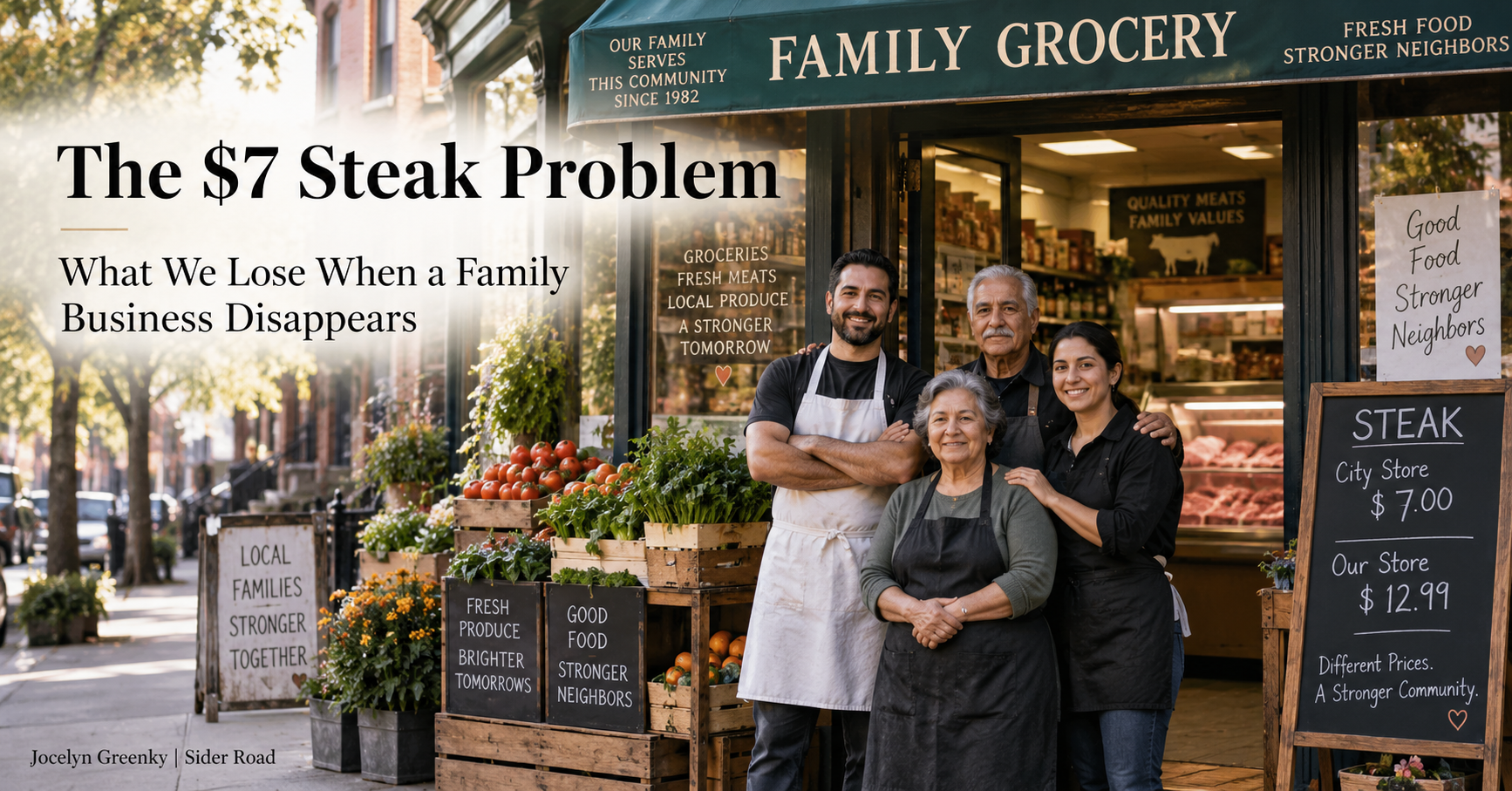
A family grocery store can survive a Costco opening down the block. It can survive COVID. It can survive inflation, thinning margins, and a changing neighborhood.
But can it survive a competitor that doesn’t have to make money?
That’s the question playing out in New York right now. Family-owned bodegas and grocers are challenging the city’s plan to open publicly subsidized supermarkets — stores that can price well below private shops precisely because turning a profit isn’t the point. The owners aren’t asking for protection. As Josefina Aguirre, who runs Little Mexico Meat Market in East Harlem with her sisters, put it: “We just want fair competition.”
Here’s what I see when I read her story, having spent years advising families through exactly these moments:
Her parents opened that store in 1997. Her father worked 28 years behind that counter and died of COVID before he ever reached the retirement he built it for. Now his daughters are carrying it forward.
That’s not just a grocery store. That’s succession — 28 years of relationships, employees, hard-won knowledge, and reputation being handed from one generation to the next.
And it’s the part we almost always undervalue. We measure a business by its revenue, its jobs, its prices. We rarely measure what vanishes when a family business does: the owner who knows three generations of a customer’s family. The neighborhood kid’s first job. The grace extended when someone’s a few dollars short at the register.
Affordable food matters — genuinely. But good policy has to ask a second question: what are we quietly dismantling while we fix something else?
In a lot of neighborhoods, family businesses aren’t just small businesses. They’re infrastructure. And once they’re gone, rebuilding what they carried is far harder than opening another store.
When we talk about protecting communities, whose survival are we actually counting?